

Last updated: September 2026 — written by James Nolan, Gymnase Tips senior trainer.
Gymnase Tips is reader-supported. Some links may be Amazon affiliate links; if you buy through them we may earn a small commission at no extra cost to you.
TL;DR — Does Calisthenics for Weight Loss Actually Work?
Calisthenics for weight loss works. A vigorous 30-minute session burns roughly 220-390 calories depending on your body weight, based on a MET value of 7.5 from the Compendium of Physical Activities. Pair that with a 300-500 cal/day deficit and you can expect 1-2 lbs of fat loss per week while holding onto muscle. Below: a sourced calorie table, a 4-modality comparison, and a progressive 8-week circuit plan.
Table of Contents
Table of contents
How Many Calories Does Calisthenics Burn?
A 155 lb person burns approximately 263 calories in 30 minutes of vigorous calisthenics. That figure comes from a straightforward formula: MET value multiplied by body weight in kilograms multiplied by duration in hours. Vigorous calisthenics carries a MET of 7.5 in the Compendium of Physical Activities. Harvard Health Publishing’s calorie table lists a slightly higher figure — 306 calories at 155 lbs — likely due to rounding and methodology differences.
Here is the full breakdown across five weight classes and four durations. Every number uses the same formula: Calories = MET (7.5) x body weight (kg) x time (hours).
| Body Weight | 15 min | 30 min | 45 min | 60 min |
|---|---|---|---|---|
| 130 lb (59 kg) | 111 | 221 | 332 | 443 |
| 155 lb (70 kg) | 131 | 263 | 394 | 525 |
| 180 lb (82 kg) | 154 | 308 | 461 | 615 |
| 205 lb (93 kg) | 174 | 349 | 523 | 698 |
| 230 lb (104 kg) | 195 | 390 | 585 | 780 |
These numbers assume continuous vigorous effort — think circuit-pace push-ups, burpees, pull-ups, and jump squats with minimal rest. Drop the intensity and the burn drops with it.
Light vs Moderate vs Vigorous — Intensity Matters
Intensity is the single biggest variable in your calorie burn. Vigorous calisthenics (MET 7.5) burns nearly 2.7 times more calories per minute than light calisthenics (MET 2.8), according to the Compendium of Physical Activities.
The three tiers break down like this:
- Light effort (MET 2.8): Slow-paced stretching, basic planks with long rest. A 155 lb person burns about 98 cal in 30 minutes.
- Moderate effort (MET 3.8): Controlled push-ups, bodyweight squats, moderate pace. Same person burns roughly 133 cal.
- Vigorous effort (MET 7.5): Circuit-pace training, minimal rest between exercises, compound movements like burpees, pull-ups, and jump lunges. Now you hit 263 cal.
The takeaway is simple. If your calisthenics sessions feel easy, they probably burn less than a brisk walk. Push the pace, shorten rest periods, and pick compound movements. That is what separates a fat-loss circuit from a warm-up.
Why Calisthenics Burns Fat (Not Just Calories)
Calisthenics drives fat loss through three mechanisms beyond the session calorie burn: EPOC afterburn, muscle preservation during a deficit, and long-term metabolic rate increase from added lean mass.
EPOC (afterburn effect). After a vigorous resistance circuit, your body continues burning calories at an elevated rate for hours. LaForgia et al. found that EPOC adds roughly 6-15% of the total session energy cost, with heavy resistance work producing elevated metabolic rates for 15-38 hours post-exercise in high-volume protocols (30-60 set sessions) — a typical 25-30 minute calisthenics circuit will land on the lower end of that duration range. On a 263-calorie session, that is an extra 16-39 calories. Modest per session, meaningful over weeks.
Muscle preservation in a deficit. This is where calisthenics earns its edge over pure cardio. Resistance training signals your body to keep muscle tissue even when calories are restricted. Barakat et al.’s review in the Strength and Conditioning Journal confirmed that resistance-training beginners can simultaneously lose fat and gain muscle in their first several months of training. Calisthenics is resistance training. Your muscles do not care whether the load comes from a barbell or your own body weight.
Higher resting metabolic rate. Each pound of muscle burns roughly 6 calories per day at rest (skeletal muscle metabolic rate: 13 kcal/kg/day) — not the “50 calories per pound” myth you see on fitness blogs, but a real contributor over months of training (Elia, 1992; validated by Wang et al., American Journal of Clinical Nutrition, 2010). The more lean mass you carry, the more energy you expend doing nothing.
For a structured bodyweight circuit approach, see our bodyweight circuit training guide.
Calisthenics vs Cardio vs Weights vs HIIT for Fat Loss
No single modality wins every category. Calisthenics offers the strongest balance of calorie burn, muscle retention, and zero equipment cost. Here is how the four stack up at 155 lbs for 30 minutes, using Harvard Health Publishing data and Compendium MET values.
| Modality | Cal / 30 min (155 lb) | EPOC Estimate | Muscle Building | Equipment Needed |
|---|---|---|---|---|
| Vigorous Calisthenics | 263-306 | 6-15% of session | High (compound resistance) | None (pull-up bar optional) |
| Running (5 mph) | 288 | 3-6% of session | Low | Running shoes |
| Vigorous Weight Lifting | 216 | 6-15% of session | Highest | Full gym |
| HIIT (mixed) | 300-400 (estimated) | 6-15% of session | Moderate | Varies |
When each wins. Running burns comparable calories per session but does little for muscle mass — long-term, that means a slower resting metabolic rate. Weight lifting is the best muscle builder, but session calorie burn is lower and you need a gym. HIIT torches the most calories per minute, but recovery demands are high and injury risk climbs with fatigue. Calisthenics sits in the middle: strong calorie burn, genuine resistance stimulus, zero cost, trainable anywhere.
My recommendation: if fat loss is the primary goal, calisthenics circuits 3-4 times per week with one or two easy runs fills every box. Skip HIIT-only approaches unless you have a solid strength base already.
For a dedicated HIIT bodyweight plan, see our bodyweight HIIT workout plan.
8-Week Calisthenics Fat Loss Plan
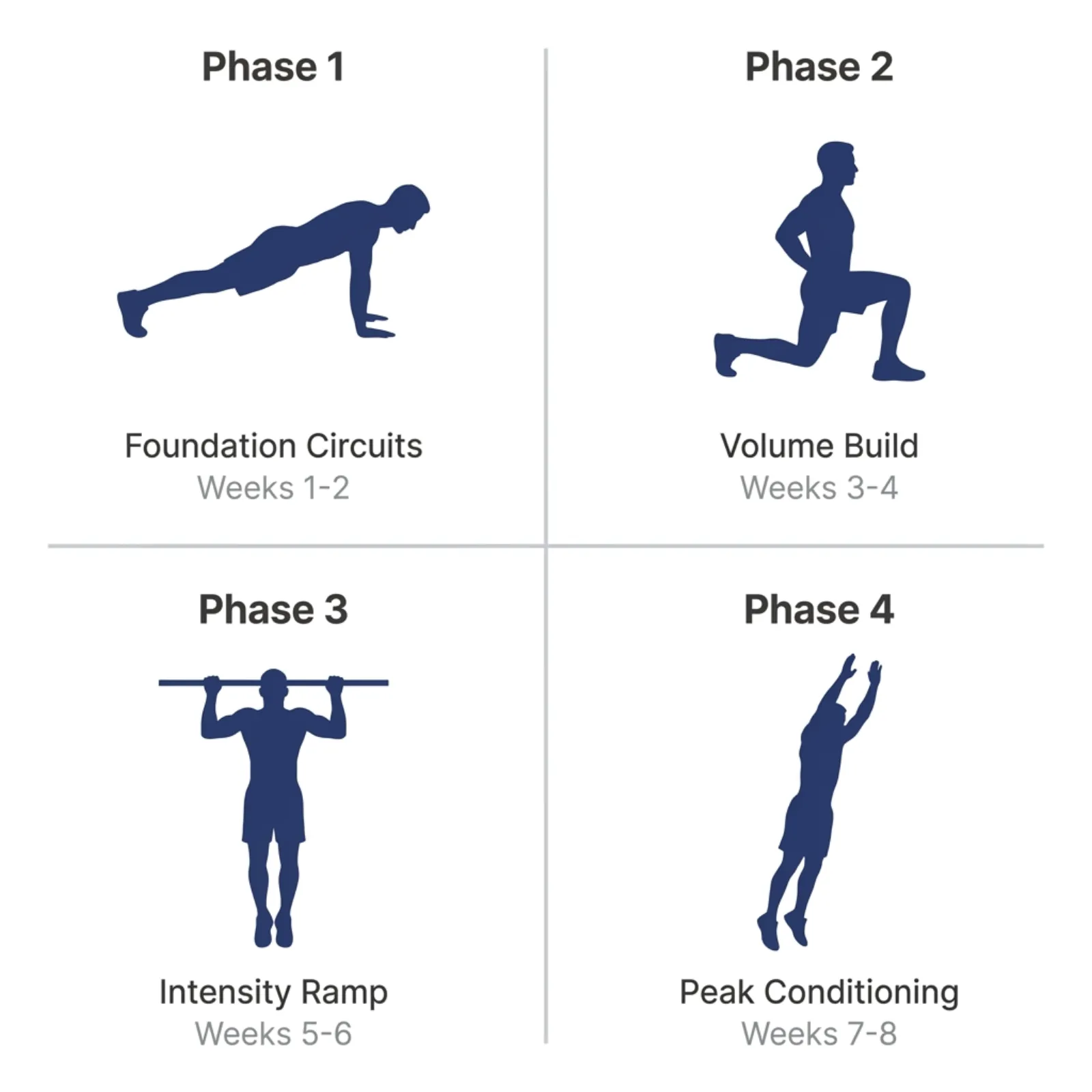
This 8-week plan uses four progressive phases — each two weeks — starting with foundational circuits and building to EMOM conditioning, with a built-in deload at week 4. Every phase includes push, pull, squat, hinge, and core movements. No missing muscle groups.
Before every session (warm-up, 5 min):
- Arm circles — 15 forward, 15 backward
- Leg swings — 10 each leg, front-to-back and side-to-side
- Bodyweight squats — 10 reps, slow and controlled
- Cat-cow stretches — 8 reps
- Inchworms — 5 reps
After every session (cool-down, 5 min):
- Standing quad stretch — 30 sec each leg
- Doorway chest stretch — 30 sec
- Seated hamstring stretch — 30 sec each leg
- Child’s pose — 45 sec
- Deep breathing — 1 min, nasal inhale, mouth exhale
New to calisthenics? Start with our beginner calisthenics routine before jumping into this fat-loss program.
Phase 1 — Foundation Circuits (Weeks 1-2)
Build movement patterns and baseline conditioning. Three sessions per week, full-body circuits.
Circuit (3 rounds, 60 sec rest between rounds):
- Push-ups — 8-12 reps (knees if needed)
- Australian rows (inverted rows on a bar or table edge) — 8-12 reps
- Bodyweight squats — 12-15 reps
- Glute bridges — 12 reps
- Dead hangs or negative pull-ups — 5-10 sec holds or 3-5 negatives
- Plank — 20-30 sec
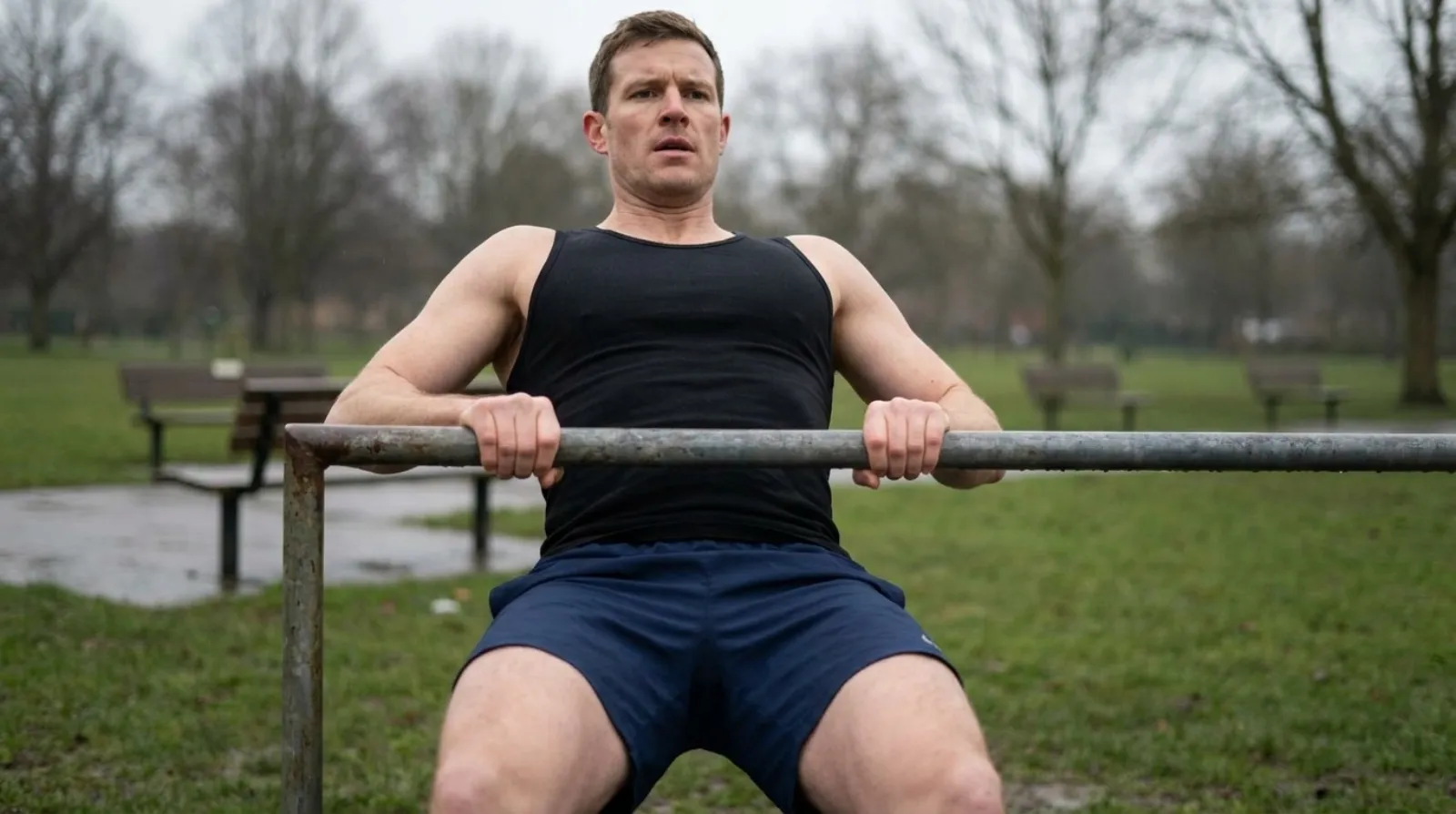
Rest 30 seconds between exercises. Each session should take about 25-30 minutes including warm-up and cool-down. If 3 rounds feel manageable by the end of week 2, you are ready for Phase 2.
Phase 2 — Volume Build (Weeks 3-4, Deload Week 4)
Add volume — one extra round and 2-3 more reps per exercise compared to Phase 1. Week 4 is a deload.
Circuit (4 rounds, 60 sec rest between rounds):
- Push-ups — 10-15 reps
- Australian rows — 10-15 reps
- Lunges (alternating) — 10 each leg
- Romanian deadlift (single-leg, bodyweight) — 8 each leg
- Negative pull-ups — 5 reps (3-5 sec lowering)
- Mountain climbers — 20 reps (10 each side)
- Hollow body hold — 20 sec
Week 4 deload: Cut volume by 40% — drop to 2 rounds, same reps, same exercises. Keep intensity the same. Deload weeks matter for fat loss because chronically elevated cortisol from overtraining promotes fat storage and muscle breakdown. One easy week resets the hormonal environment.
Phase 3 — Intensity Ramp (Weeks 5-6)
Shorten rest periods and introduce supersets. Pull-up progression moves from negatives to assisted or full pull-ups.
Superset format (4 rounds, 45 sec rest between supersets):
- Superset A: Diamond push-ups (8-10) + Pull-ups or band-assisted pull-ups using resistance bands (5-8)
- Superset B: Jump squats (10) + Single-leg Romanian deadlift (8 each)
- Superset C: Pike push-ups (8-10) + Australian rows, feet elevated (10-12)
- Finisher: Burpees — 8 reps, then 30-sec plank
The shorter rest and superset pairing spike heart rate and increase calorie density per minute. Sessions run about 30-35 minutes.
For more lower-body options in Phases 3-4, check our calisthenics leg workout.
Phase 4 — Peak Conditioning (Weeks 7-8)
EMOM (every minute on the minute) format. Highest calorie burn density of the program.
EMOM — 20 minutes (rotate through 5 exercises, 4 full rounds):
- Minute 1: Push-ups — 12-15 reps
- Minute 2: Pull-ups — 6-10 reps (band-assist as needed)
- Minute 3: Jump lunges — 12 reps (6 each leg)
- Minute 4: Burpees — 8 reps
- Minute 5: Hanging knee raises — 10 reps
Whatever time remains in each minute is your rest. As conditioning improves, the work portion grows and rest shrinks — built-in progressive overload without changing a single variable.
For Phase 4, adding a weighted vest (start at 5-10% of body weight) increases the load on every movement without changing the programming.
After Week 8: You have two paths. If strength and skill progression is the next goal, transition to a full beginner-to-advanced calisthenics plan, or move into our advanced calisthenics workout if you are ready for skill work. If fat loss is still the priority, repeat the 8-week cycle with added load — the weighted vest, slower eccentrics, or harder progressions (archer push-ups, pistol squats). Do not just re-run the same program at the same difficulty.
For a structured challenge to bridge into your next cycle, try our 28-day calisthenics challenge.
Sleep, Stress and Recovery — The Fat-Loss Multiplier Nobody Mentions

Sleep under 5.5 hours per night cuts fat loss by roughly 55% even when calorie intake is identical. That finding comes from Nedeltcheva et al.’s controlled crossover study at the University of Chicago, published in the Annals of Internal Medicine. Participants on the same calorie-restricted diet lost 1.4 kg of fat with 8.5 hours of sleep opportunity versus just 0.6 kg with 5.5 hours — and the sleep-restricted group lost 60% more lean mass.
No competitor page on the first page of Google mentions this study. Zero.
The mechanism is straightforward: sleep restriction elevates ghrelin (hunger hormone), increases cortisol, and shifts your body toward burning lean tissue instead of fat. You can train perfectly and eat at a deficit, and poor sleep will undercut half the results.
Practical recovery rules:
- Sleep 7-9 hours per night. Non-negotiable for fat loss.
- Space same-muscle sessions at least 48 hours apart. The 8-week plan above is designed for 3-4 sessions per week with rest days between.
- Use active recovery on off days — a 20-30 minute walk, light stretching, or mobility work. Sitting completely still does not speed recovery.
What to Eat During a Calisthenics Cut
Set a moderate deficit of 300-500 calories per day and prioritize protein at 1.6-2.2 g per kg of body weight. The 1.6 g/kg figure comes from Morton et al.’s meta-analysis of 49 studies, which identified it as the breakpoint beyond which additional protein did not produce further gains in fat-free mass. The upper bound of 2.2 g/kg represents the 95% confidence interval from the same analysis — a reasonable ceiling for those in a caloric deficit.
The ISSN position stand on protein and exercise recommends 1.4-2.0 g/kg for exercising individuals generally, with higher intakes during hypocaloric periods.
A simple framework for a 155 lb (70 kg) person in a cut:
- Protein: 112-154 g/day (1.6-2.2 g/kg)
- Deficit: 300-500 cal/day below maintenance (use a TDEE calculator as a starting point, then adjust based on weekly weigh-ins)
- Meal timing: Distribute protein across 3-4 meals. Pre-sleep casein or a protein-rich snack supports overnight muscle protein synthesis (ISSN position stand: “Pre-sleep casein protein intake (30-40 g) provides increases in overnight MPS”).
This is not a full nutrition guide. The point is simple: protect your muscle with protein, create a moderate deficit with food, and let your training handle the rest. Aggressive deficits (800+ cal/day) accelerate muscle loss and crash your training performance.
5 Mistakes That Stall Calisthenics Fat Loss
The most common mistake is expecting calisthenics to target belly fat specifically. Spot reduction is a myth. Vispute et al. assigned subjects to six weeks of abdominal exercises five days per week and found zero reduction in abdominal fat compared to controls. Fat loss is systemic. Your body decides where it comes off.
- Chasing spot reduction. Ab-focused routines do not burn belly fat. Full-body circuits in a calorie deficit do.
- Skipping pull movements. Push-up-only programs create imbalances and leave calories on the table. Rows and pull-ups recruit large back muscles that drive higher energy expenditure. Every phase of the plan above includes pulling.
- Never deloading. Training hard 52 weeks straight elevates cortisol and stalls fat loss. One reduced-volume week every 3-4 weeks resets the hormonal environment. Week 4 of the plan is built for this.
- Sleeping 5-6 hours and wondering why the scale won’t move. See the recovery section above. Sleep restriction cut fat loss by 55% in a controlled study.
- No progressive overload. Doing the same 3×10 push-ups for months produces diminishing returns. Add reps, reduce rest, progress to harder variations. The 8-week plan handles this automatically through phased progression.
For more home-based fat-loss training options, see our guide to fat loss exercises at home.
How to Track Your Progress
Track waist circumference and strength progress, not just the scale. Body recomposition — losing fat while gaining muscle — can hold your weight perfectly steady while your body composition transforms dramatically (Barakat et al., 2020).
Better metrics than the scale alone:
- Waist circumference: Measure at the navel, same time of day, weekly. A shrinking waist with a stable scale means recomposition is working.
- Strength PRs: If your push-up count and pull-up reps keep climbing while weight stays flat, you are gaining muscle and losing fat.
- Progress photos: Same lighting, same angle, every two weeks. The mirror lies less than the scale.
- Body fat estimation: Calipers or a smart scale give rough trends. Do not obsess over the number — track the direction.
Expect the scale to be erratic in the first 2-3 weeks. Water retention from new training stimulus masks fat loss. Trust the waist tape.
FAQ
Is calisthenics good for losing weight?
Yes. Vigorous calisthenics burns 220-390 calories per 30-minute session depending on body weight (Source: Compendium of Physical Activities, MET 7.5). Combined with a moderate calorie deficit, that rate supports 1-2 lbs of fat loss per week. The added muscle-preservation benefit gives calisthenics an edge over cardio-only approaches for long-term body composition.
How long does it take to lose weight with calisthenics?
Most people notice measurable changes within 4-6 weeks of consistent training (3-4 sessions/week) paired with a 300-500 cal/day deficit. At a rate of 1-2 lbs per week, a 10 lb fat loss takes 5-10 weeks. Beginners often see faster initial results due to simultaneous muscle gain (“newbie gains”), which Barakat et al. confirmed in their 2020 review.
Can you lose belly fat with calisthenics?
Calisthenics reduces overall body fat, including belly fat — but it cannot target belly fat specifically. Vispute et al. found that six weeks of dedicated abdominal exercise produced zero localized fat reduction. Fat loss is systemic. A calorie deficit combined with full-body calisthenics circuits is the most effective approach.
How many calories does 30 minutes of calisthenics burn?
Between 221 and 390 calories at vigorous effort, depending on your body weight. A 155 lb person burns about 263 calories by the Compendium formula (MET 7.5) or 306 calories per Harvard Health’s published table. A 230 lb person burns about 390 calories. Light-effort calisthenics (MET 2.8) burns roughly a third of those numbers.
Is calisthenics better than running for fat loss?
For pure calorie burn per session, they are close — running at 5 mph burns about 288 cal/30 min at 155 lbs versus 263-306 for vigorous calisthenics (Source: Harvard Health Publishing). The difference is what happens after: calisthenics preserves and builds muscle, which maintains your resting metabolic rate during a cut. Running does not. For long-term fat loss, calisthenics is the stronger choice.
Can you build muscle and lose fat at the same time with calisthenics?
Yes, especially if you are new to resistance training. Barakat et al. reviewed multiple studies showing that beginners can simultaneously gain muscle and lose fat for their first several months of training, provided protein intake is adequate and the calorie deficit is moderate. This is called body recomposition, and calisthenics provides exactly the stimulus needed — progressive resistance training using compound movements.
Sources
- Compendium of Physical Activities — 2024 Adult Compendium, conditioning exercise MET values. pacompendium.com/conditioning-exercise
- Harvard Health Publishing — “Calories burned in 30 minutes of leisure and routine activities.” health.harvard.edu
- LaForgia, J., Withers, R.T., & Gore, C.J. (2006). “Effects of exercise intensity and duration on the excess post-exercise oxygen consumption.” Journal of Sports Sciences, 24(12), 1247-1264. tandfonline.com
- Nedeltcheva, A.V., et al. (2010). “Insufficient sleep undermines dietary efforts to reduce adiposity.” Annals of Internal Medicine, 153(7), 435-441. acpjournals.org
- Barakat, C., et al. (2020). “Body Recomposition: Can Trained Individuals Build Muscle and Lose Fat at the Same Time?” Strength and Conditioning Journal, 42(5), 7-21. journals.lww.com
- Morton, R.W., et al. (2018). “A systematic review, meta-analysis and meta-regression of the effect of protein supplementation on resistance training-induced gains in muscle mass and strength in healthy adults.” British Journal of Sports Medicine, 52(6), 376-384. pubmed.ncbi.nlm.nih.gov
- Jager, R., et al. (2017). “International Society of Sports Nutrition Position Stand: protein and exercise.” Journal of the International Society of Sports Nutrition, 14, 20. pmc.ncbi.nlm.nih.gov
- Vispute, S.S., et al. (2011). “The Effect of Abdominal Exercise on Abdominal Fat.” Journal of Strength and Conditioning Research, 25(9), 2559-2564. journals.lww.com
- Elia, M. (1992). “Organ and tissue contribution to metabolic rate.” In: Kinney JM, Tucker HN, eds. Energy Metabolism: Tissue Determinants and Cellular Corollaries. Raven Press; New York: pp. 61-80. Validated by Wang et al. (2010), American Journal of Clinical Nutrition. sciencedirect.com


Pingback: How to Get Lean Fast: Realistic 8-Week Plan
Pingback: How to Build Muscle Without Weights
Pingback: NLP for Weight Loss: Does It Actually Work? (2026)