

Progressive Overload Training: The Bodyweight & Gym Guide
By James Nolan, Gymnase Tips senior trainer | Updated September 2026
Gymnase Tips is reader-supported. Some links may be Amazon affiliate links; if you buy through them we may earn a small commission at no extra cost to you.
TL;DR — How Does Progressive Overload Training Actually Work?
Progressive overload training means systematically increasing the demands on your muscles over time — through more weight, reps, sets, tempo changes, or harder exercise variations. It is the single non-negotiable driver of strength and muscle growth. This guide covers 7 methods, bodyweight progression ladders, and a 4-week plan you can start today.
Table of contents
What Is Progressive Overload Training?
Progressive overload training is the principle of gradually increasing the stress placed on your muscles so they continue to adapt and grow. If you keep doing the same exercises with the same weight for the same reps, your body has no reason to change. Research confirms this: a 2022 study in PeerJ found that participants using progressive overload protocols gained 6.7% to 12.9% in muscle thickness over just 8 weeks, whether they progressed via load or reps (Source: Plotkin et al., PeerJ, 2022). Without progressive overload, you plateau. Period.
If lifting isn’t your entry point, our guide on how to build muscle without weights covers the same principle from a pure-bodyweight angle.
7 Ways to Apply Progressive Overload
There are seven ways to apply progressive overload, and you do not need a barbell for any of them.
- Increase weight — add 2.5-5% more load per session on compound lifts. The NSCA textbook recommends load increases of 2.5-10 lbs for upper body and 5-15 lbs for lower body exercises, depending on athlete size and training status, using the “2-for-2 rule”: if you can do 2 extra reps on your last set for 2 consecutive sessions, increase the load (Source: Haff & Triplett, Essentials of Strength Training and Conditioning, 4th ed., Ch. 17, NSCA, 2016).
- Increase reps — add 1-2 reps per set before adding weight. Hit the top of your target rep range, then bump the load.
- Increase sets — add one working set per exercise. A 2025 meta-regression of 67 studies (2,058 participants) found that higher weekly set volume was associated with greater muscle growth, with a 100% posterior probability that the relationship is positive, though with diminishing returns at higher volumes (Source: Pelland et al., Sports Medicine, 2025).
- Slow the tempo — use a 3-1-2 cadence (3 seconds down, 1-second pause, 2 seconds up) to increase time under tension.
- Reduce rest periods — cut 15 seconds between sets. Same work in less time forces metabolic adaptation.
- Increase range of motion — deeper squats, deficit push-ups using push-up handles. Greater ROM means more mechanical tension per rep.
- Progress to a harder variation — diamond push-ups instead of standard, pistol squats instead of air squats. This is the primary progression tool for bodyweight training.
Which Method Should You Use? (Decision Table)
The right method depends on where you are stuck — use this table to pick.
| Method | Best When | Example |
|---|---|---|
| Add weight | You finish all sets/reps at RPE 7 or below | Squat 60 kg → 62.5 kg next session |
| Add reps | You are near the top of a rep range | 3×8 → 3×10, then increase load |
| Add sets | You recover well but growth has stalled | 3 sets → 4 sets of bench press |
| Slow tempo | You want more stimulus without adding load | 3-1-2 cadence on pull-ups |
| Cut rest | Endurance or conditioning is a goal | 90s rest → 75s rest between sets |
| Increase ROM | You have hit a strength plateau at current depth | Parallel squat → ATG squat |
| Harder variation | Bodyweight training or no access to heavier loads | Standard push-up → archer push-up |
Bodyweight Progressive Overload — The Progression Ladder
You can progressive overload with bodyweight alone by moving through harder exercise variations. The table below maps five levels for every major movement pattern.
| Movement | Level 1 | Level 2 | Level 3 | Level 4 | Level 5 |
|---|---|---|---|---|---|
| Push | Wall push-up | Incline push-up | Standard push-up | Diamond push-up | Archer push-up |
| Pull | Dead hang (30s) | Australian row | Band-assisted pull-up (resistance bands) | Full pull-up (doorway pull-up bar) | Archer pull-up |
| Squat | Assisted squat (holding support) | Air squat | Bulgarian split squat | Shrimp squat | Pistol squat |
| Hinge | Glute bridge | Single-leg glute bridge | Romanian deadlift (bodyweight) | Nordic curl, eccentric (Nordic curl strap) | Full Nordic curl |
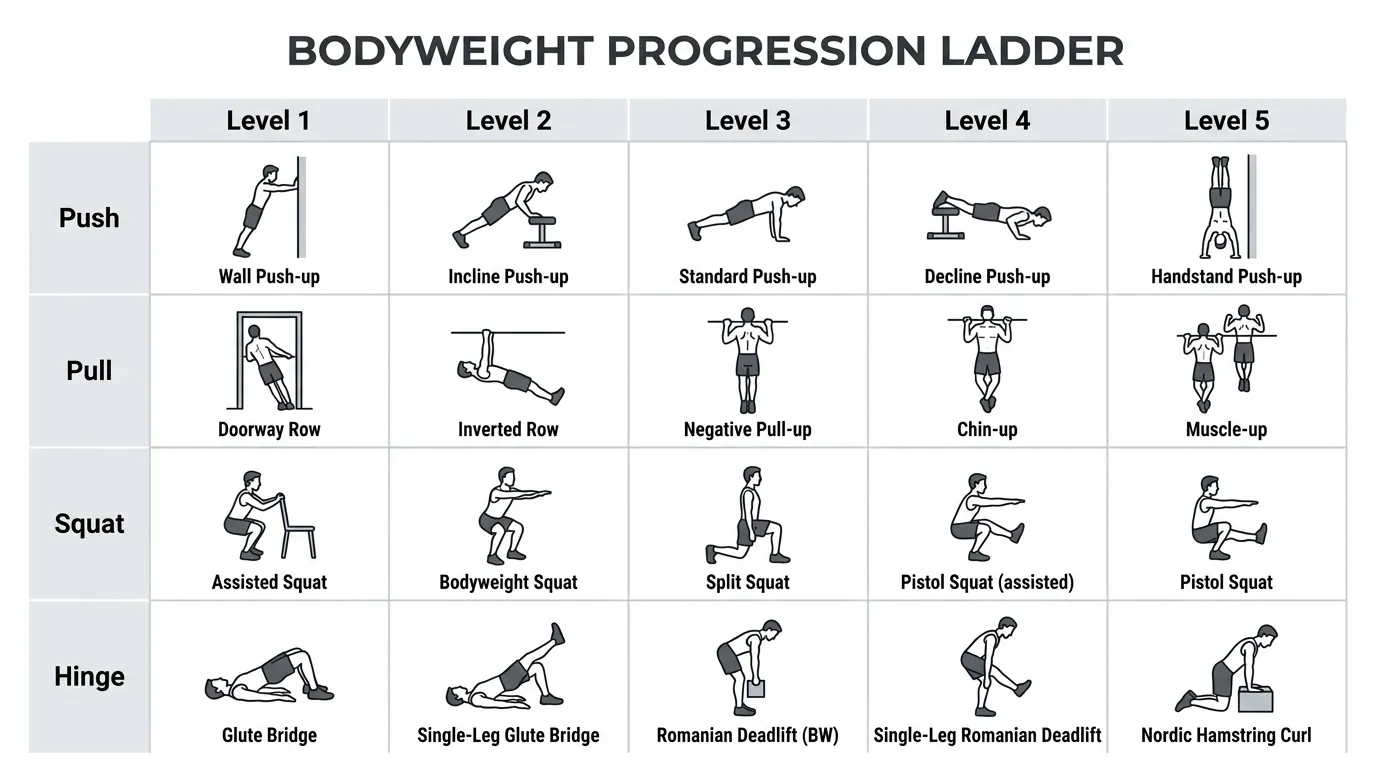
How to use this ladder: stay at your current level until you can perform 3 sets of 12 clean reps with full range of motion. Then move to the next level and reset to 3 sets of 5-6 reps. Build back up. That is progressive overload without touching a single weight plate.
For a full progression path across every session, see our calisthenics workout plan, or target legs specifically with a bodyweight leg day routine.
4-Week Bodyweight Progressive Overload Plan
This 4-week plan uses only bodyweight and applies progressive overload through rep increases and exercise upgrades each week. Three sessions per week, full body. Optional: add resistance bands for external load on any movement.
| Week | Push | Pull | Squat | Hinge | Progression Method |
|---|---|---|---|---|---|
| 1 | 3×8 standard push-up | 3×8 Australian row | 3×8 air squat | 3×10 glute bridge | Baseline — establish your working level |
| 2 | 3×10 standard push-up | 3×10 Australian row | 3×10 air squat | 3×12 glute bridge | Add reps (+2 per set) |
| 3 | 3×12 standard push-up | 3×12 Australian row | 3×12 air squat | 3×12 single-leg glute bridge | Add reps or upgrade variation |
| 4 | 3×6 diamond push-up | 3×6 band-assisted pull-up | 3×8 Bulgarian split squat | 3×8 single-leg glute bridge | Upgrade variation, reset reps |
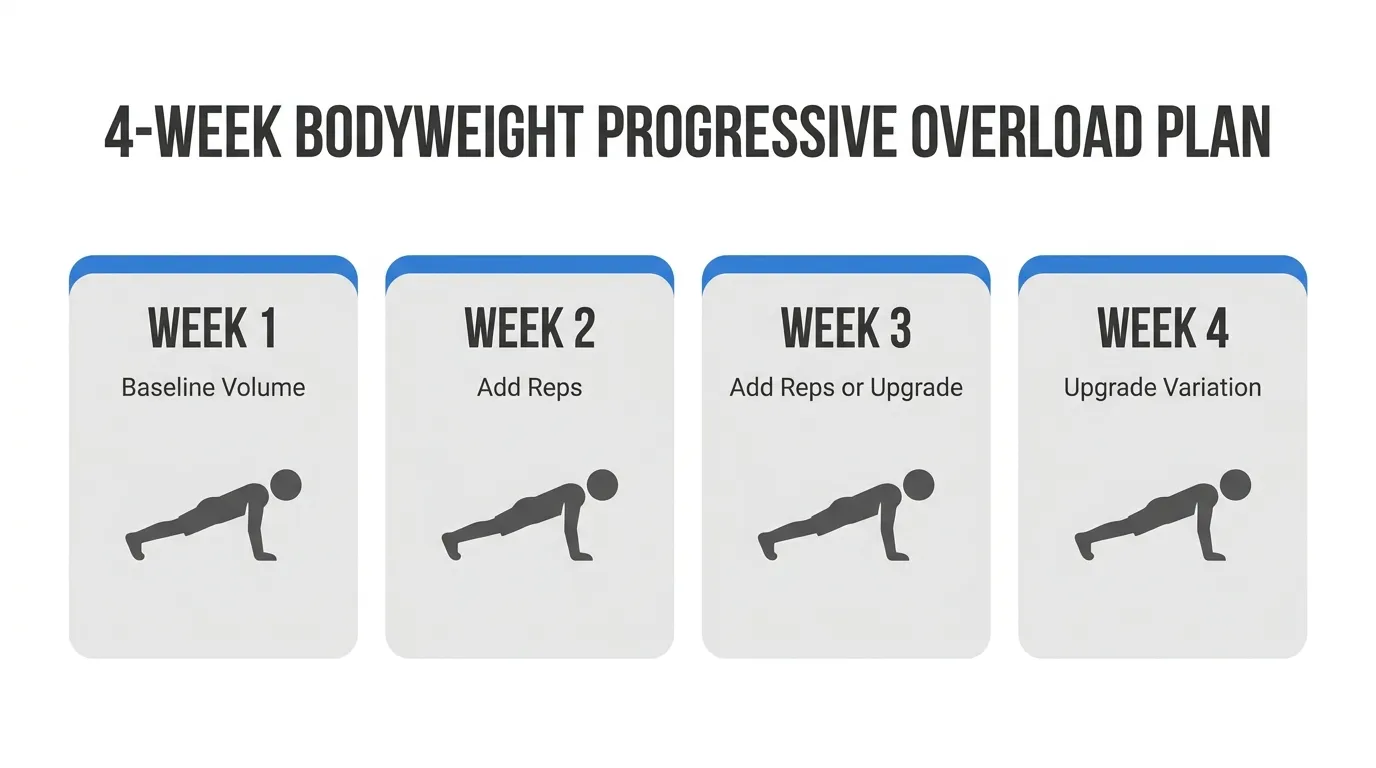
Week 4 is where the real overload happens. You move up a level on the progression ladder and drop back to lower reps. Then you repeat the 4-week cycle at the new level.
If you train with both bodyweight and dumbbells, a hybrid training program combining bodyweight and dumbbells gives you more loading options.
Deload note: after two full cycles (8 weeks), take a recovery week at 50% volume. Intermediate lifters generally benefit from a deload every 4-8 weeks, depending on training intensity and individual recovery capacity (Source: Bell et al., Strength and Conditioning Journal, 2026).
Progressive Overload for Military PT Tests
Progressive overload applies directly to military PT test prep — here is a 4-week push-up micro-cycle you can use for APFT or ACFT training.
The mistake most service members make with PT test prep is grinding max-rep sets to failure every session. That builds fatigue, not capacity. Instead, use structured progressive overload with manipulated rest periods and volume.
4-Week Push-Up Micro-Progression:
| Week | Protocol | Rest Between Sets | Total Volume Target |
|---|---|---|---|
| 1 | 3 x max reps | 90 seconds | Establish baseline total |
| 2 | 3 x max reps | 75 seconds | Same or higher total, less rest |
| 3 | 4 x max reps | 75 seconds | Add a set, maintain reduced rest |
| 4 | 4 x max reps | 60 seconds | Peak density — test readiness |
Apply the same structure to sit-ups. For the 2-mile run, progressive overload looks different: reduce your interval rest by 10 seconds each week or add one repeat per week at your target pace.
The key insight here is that reducing rest periods is progressive overload, even without adding reps. You are doing the same work in less time, which forces your body to recover faster — exactly what the PT test demands.
Grip fatigue often limits pull-up and rope-climb numbers before the target muscle does — if that’s holding your score back, see our grip strength training guide.
How to Tell When to Progress (RPE/RIR Guide)
Use RPE (Rate of Perceived Exertion) to decide when you are ready to add load. If your working sets finish at RPE 7 or below, increase the demand next session. RPE-based autoregulation was validated for resistance training by Helms et al., who demonstrated that RIR-based RPE scores closely track actual proximity to failure, particularly in trained lifters (Source: Helms et al., Strength and Conditioning Journal, 2016).
| RPE | Reps in Reserve (RIR) | What It Feels Like | Action |
|---|---|---|---|
| 7 | 3 RIR | Could do 3 more reps. Comfortable. | Increase load or reps next session |
| 8 | 2 RIR | Could do 2 more. Challenging but controlled. | You are in the productive training zone |
| 9 | 1 RIR | One rep left in the tank. Hard. | Hold here — this is your ceiling for working sets |
| 10 | 0 RIR | Failure. Could not complete another rep. | Too far for regular training. Save for testing. |
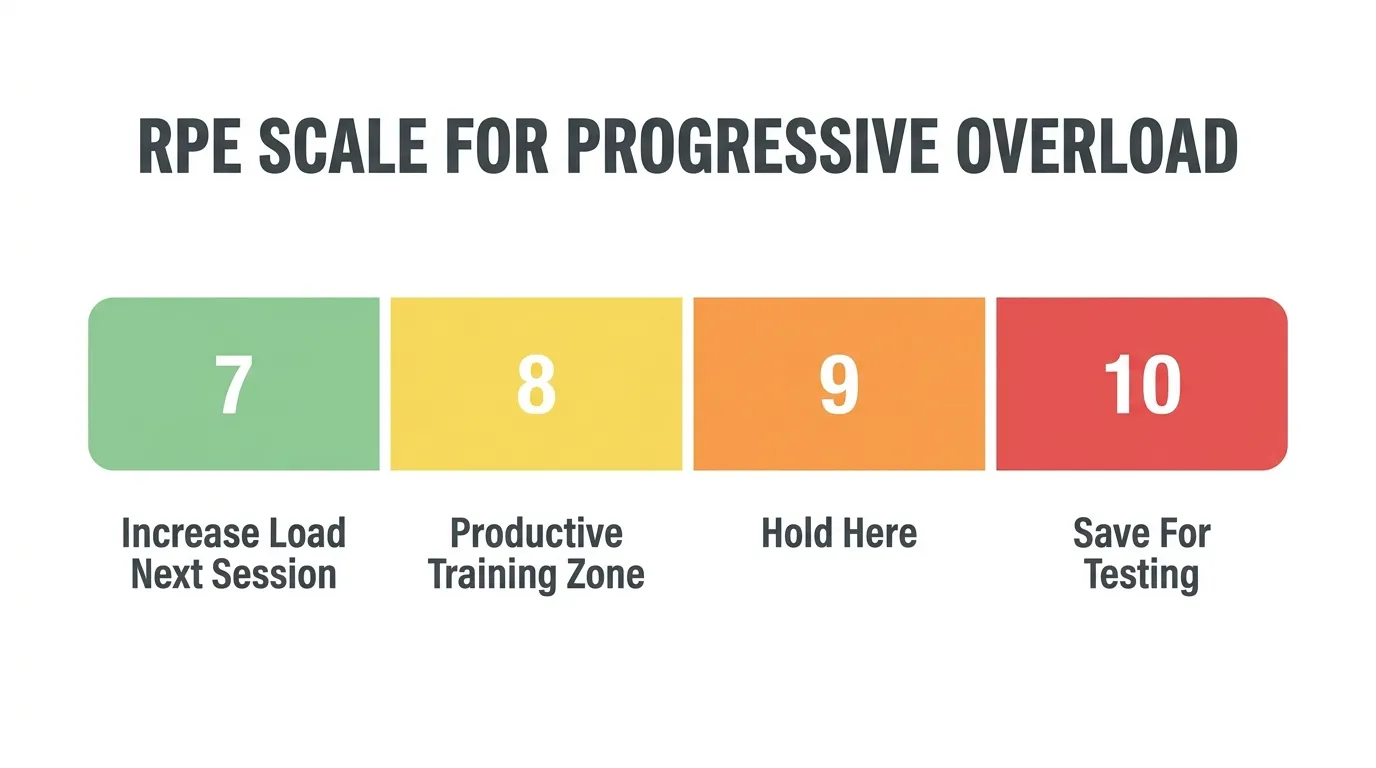
Most of your working sets should land at RPE 7-8. That is the sweet spot where you accumulate enough stimulus to grow without digging a recovery hole you cannot climb out of.
Why Your Progressive Overload Is Not Working
If you are stuck, the problem is almost always one of these five things: inconsistent tracking, jumping load too fast, poor recovery, insufficient protein, or switching programs before adaptation occurs.
1. You are not tracking. If you do not write down your sets, reps, and loads, you have no idea whether you actually progressed. Use a notebook or an app. Memory is unreliable.
2. You are jumping too fast. Adding 10 kg when 2.5 kg would do is ego lifting disguised as progressive overload. The NSCA recommends small, structured load jumps for a reason. Fractional weight plates exist — use them.
3. You are not sleeping enough. Muscle grows during recovery, not during training. Adults need 7-9 hours per night (Source: NHLBI/NIH, 2022). Non-negotiable.
4. You are not eating enough protein. A meta-analysis of 49 studies (1,863 participants) found that protein supplementation beyond 1.62 g/kg/day did not produce additional gains in fat-free mass, with a 95% confidence interval ceiling of 2.2 g/kg/day (Source: Morton et al., British Journal of Sports Medicine, 2018). A larger 2022 review of 74 RCTs confirmed this threshold, finding that protein intake above approximately 1.6 g/kg/day provided no further lean mass benefits when combined with resistance training (Source: Nunes et al., Journal of Cachexia, Sarcopenia and Muscle, 2022). If you weigh 80 kg, that is 130-176 g of protein daily. Track it.
5. You are program-hopping. A program needs at least 6-8 weeks to produce measurable strength and hypertrophy changes. Plotkin et al. (2022) demonstrated significant muscle thickness gains over an 8-week protocol, and research consistently shows neural adaptations become measurable within the first 4 weeks, with hypertrophy following by weeks 6-8 (Source: ACSM Position Stand, Medicine & Science in Sports & Exercise, 2009). Switching every 3 weeks means you never actually overload anything — you just keep restarting.
Skip the fancy periodization schemes until you have mastered these basics. A simple linear progression with consistent tracking will outperform any advanced program executed inconsistently.
If program-hopping is your issue, commit to a structured template like a 5-day split workout or a 4-day workout split for at least 6-8 weeks before judging results.
FAQ
How often should you progressive overload?
Beginners can increase load or reps every 1-2 weeks. Intermediates typically progress every 2-4 weeks. The deciding factor is training age, not calendar age. If you are still adding weight every session, you are a beginner — keep going until that stops working.
Can you progressive overload without weights?
Yes. Use harder exercise variations, slower tempos, greater range of motion, shorter rest periods, or more sets. The bodyweight progression ladder table above maps five difficulty levels for push, pull, squat, and hinge patterns. Resistance bands add external load for bodyweight progression without needing a full gym.
When should I increase weight in progressive overload?
When you can complete all prescribed sets and reps with good form at RPE 7 or below — meaning you could do at least 3 more reps per set. Check the RPE/RIR table above for the full scale.
Why is my progressive overload not working?
The five most common reasons are inconsistent tracking, excessive load jumps, inadequate sleep, insufficient protein intake, and switching programs too often. See the full troubleshooting section above.
What is the 3-2-1 progressive overload method?
The 3-2-1 method structures each exercise as 3 heavy sets (low reps, high load), 2 moderate sets (moderate reps and load), and 1 light burnout set (high reps to near-failure). It combines strength and hypertrophy stimuli in a single session. Useful for intermediate lifters who want both strength and size work without separate training blocks.
What is the 5/3/1 rule?
5/3/1 is Jim Wendler’s strength program, not a universal rule. It uses a 4-week cycle: Week 1 at 65/75/85% of your training max for sets of 5, Week 2 at 70/80/90% for sets of 3, Week 3 at 75/85/95% for sets of 5/3/1, and Week 4 as a deload at 40/50/60%. The final set each week is AMRAP (as many reps as possible), built around the squat, bench, deadlift, and overhead press.
Sources
- Plotkin, D., Coleman, M., Van Every, D., et al. (2022). “Progressive overload without progressing load? The effects of load or repetition progression on muscular adaptations.” PeerJ, 10, e14142. pmc.ncbi.nlm.nih.gov
- Pelland, J. C., Remmert, J. F., Robinson, Z. P., et al. (2025). “The Resistance Training Dose Response: Meta-Regressions Exploring the Effects of Weekly Volume and Frequency on Muscle Hypertrophy and Strength Gains.” Sports Medicine, 56(2), 481-505. pubmed.ncbi.nlm.nih.gov
- Morton, R. W., Murphy, K. T., McKellar, S. R., et al. (2018). “A systematic review, meta-analysis and meta-regression of the effect of protein supplementation on resistance training-induced gains in muscle mass and strength in healthy adults.” British Journal of Sports Medicine, 52(6), 376-384. pubmed.ncbi.nlm.nih.gov
- Nunes, E. A., Colenso-Semple, L., McKellar, S. R., et al. (2022). “Systematic review and meta-analysis of protein intake to support muscle mass and function in healthy adults.” Journal of Cachexia, Sarcopenia and Muscle, 13(2), 795-810. pubmed.ncbi.nlm.nih.gov
- Helms, E. R., Cronin, J., Storey, A., & Zourdos, M. C. (2016). “Application of the Repetitions in Reserve-Based Rating of Perceived Exertion Scale for Resistance Training.” Strength and Conditioning Journal, 38(4), 42-49. pubmed.ncbi.nlm.nih.gov
- Haff, G. G. & Triplett, N. T., Eds. (2016). Essentials of Strength Training and Conditioning, 4th ed. Champaign, IL: Human Kinetics / NSCA. Chapter 17.
- Bell, L., et al. (2026). “A Practical Approach to Deloading: Recommendations and Considerations for Strength and Physique Sports.” Strength and Conditioning Journal, 48(4), 413-423. DOI: 10.1519/SSC.0000000000000910.
- NHLBI/NIH. “How Much Sleep Is Enough?” nhlbi.nih.gov
- ACSM Position Stand: Ratamess, N. A., et al. (2009). “Progression Models in Resistance Training for Healthy Adults.” Medicine & Science in Sports & Exercise, 41(3), 687-708. pubmed.ncbi.nlm.nih.gov
- Wendler, J. (2011). 5/3/1: The Simplest and Most Effective Training System for Raw Strength. jimwendler.com
- Cleveland Clinic. “Your Simple Guide to Progressive Overload Training.” clevelandclinic.org